ZEP’S HOW-TO MYTHBUSTERS: STABILITY FOR DESCENDING AND CORNERS
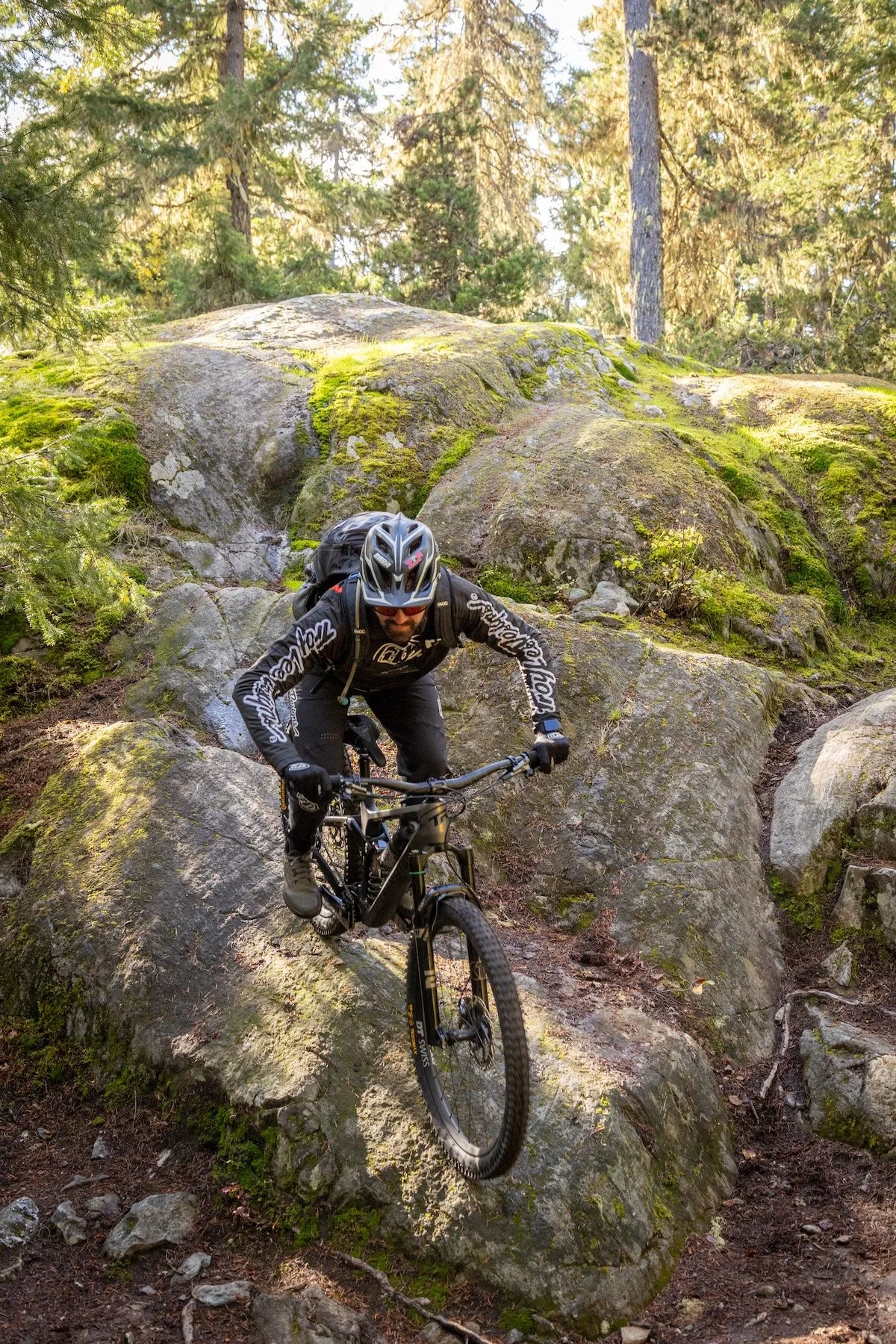
Lean back on steeps? Thankfully we’ve moved past that… chin over stem, centred and mobile… hells yeah!
Understanding Stability & Balance on the Bike
Stability is one of the most important — and often misunderstood — elements of mountain bike technique, particularly when it comes to descending.
Over the years, bikes, trails, and riding styles have changed dramatically, and so has our understanding of how riders should position themselves on the bike. What matters most is not memorizing a single “correct” position, but understanding how different positions affect stability, balance, traction, and control.
Rather than thinking about technique as simply right or wrong, it’s more helpful to look at the pros and cons of different approaches and learn how to adapt your position depending on terrain, speed, and riding style.
Let’s take a closer look at how body position works when descending and how riders can stay balanced, stable, and in control on the bike. While most riders and coaches today recognize that staying balanced and centered on the bike is generally more effective, this older explanation still occasionally appears in videos, articles, and conversations within the sport.
Understanding where this advice came from — and how modern riding has evolved — helps riders build a clearer understanding of stability (positioning), balance, and control on the bike.
The Bikes
In the early days of mountain biking, bikes were very different from what we ride today.
Typical bikes in the 1990s had:
steeper head angles
shorter wheelbases
limited suspension
fixed seat heights
Because the saddle was usually all the way up for pedaling, the only way for riders to lower their centre of mass on descents was often to move their hips behind the saddle.
Within that context, the technique made sense.
However, modern bikes have evolved significantly:
longer wheelbases
slacker geometry
improved suspension
adjustable dropper posts
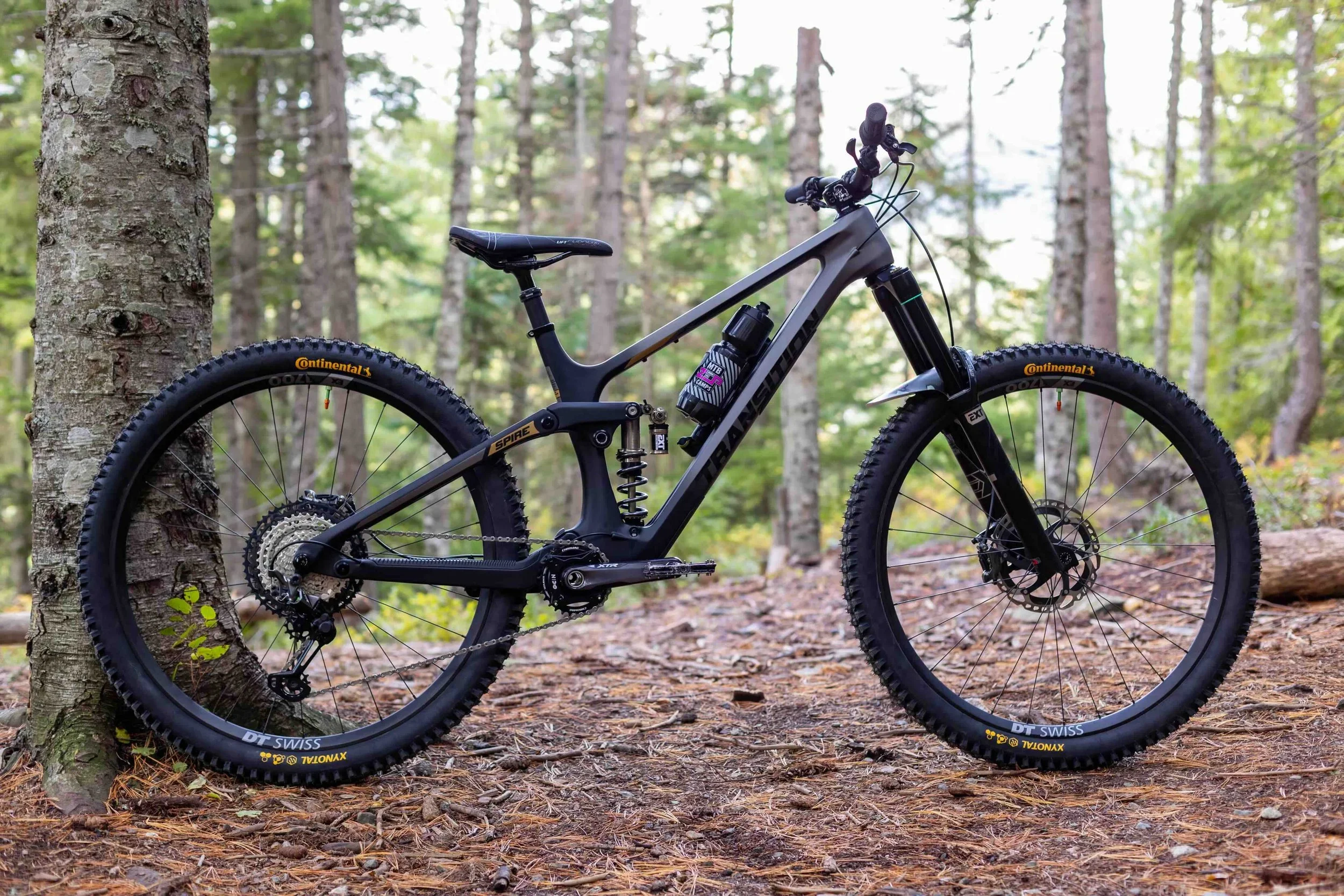
With the ability to lower the saddle and move freely on the bike, riders can now maintain a much more centered position, which improves both stability and traction.

CONTINUED EDUCATION
Another reason this idea persisted is simply a misunderstanding of the physics involved in descending on a bike.
In every sport, techniques can sometimes be repeated without fully understanding why they work. Over time those explanations get passed along through videos, magazines, and coaching systems.
This is why continuing education for coaches is so important.
At ZEP Mountain Bike Coaching, the approach to teaching riding skills is informed by the GSMBC coaching framework, which emphasizes understanding the mechanics of riding rather than simply copying technique.
When riders understand the why behind a movement, it becomes far easier to apply the skill in different terrain and situations.
Stability & Balance
Within the GSMBC riding skills framework, two key concepts underpin effective riding technique: Stability & Balance.
These two elements work together constantly when riding.
Stability — the ability to resist forces
The more stable a rider is, the harder they are to push off balance.
Greater stability allows riders to resist forces coming from the terrain.
On the bike, this means keeping your weight centered between the two wheels, improving:
stability
traction
range of movement and overall control.
The three core things that impact stability are
Rider position: From a physics standpoint, the lower and more centered an object’s centre of mass, the more stable it becomes (its more difficult to push over - think ‘lamp’ vs ‘picnic table’). However, bending the joints causes the rider to support their mass less through their bones and more through their muscles, increasing fatigue…
Fatigue: Tired muscles = weak muscles = lower stability! A rider must continually adjust their position to maximize the COM relative to the wheels, but also efficiency so they don’t get too tired.
Strength: In simple terms, the stronger a rider, the more they can resist forces. This is why athletes train in the gym!
Balance — the movements you make to manage instability
A rider is never perfectly stable on a bike. Terrain is constantly changing, and the bike is always moving underneath you.
Balance refers to the adjustments riders make to maintain control.
The less stable a rider is, the more balancing is required.
Balancing movements help riders regain stability.
A greater range of movement makes balancing easier.
In simple terms, Stability & Balance are two sides of the same coin.
A strong riding position provides the stability needed to resist terrain forces, while mobility allows riders to adapt and stay balanced.
The Solution: TALL, Centred & MOBILE
In simple terms, rather than moving back (classic old school technique!) or getting too low (many new riders stay centred but crouch too low, too much of the time causing fatigue) on a descent, riders generally perform best when standing and moving from a taller, NEUTRAL position on the bike.
This improves:
stability: the rider is centred, with good traction on both wheels
efficiency: the rider is supported by their bones instead of their muscles
mobility: the rider can move the bike in all directions, underneath them to help balance and adapt to the trail
traction: even weight distribution helps improve traction front and rear
Being centred also allows the bike to move freely beneath the rider as the terrain changes. Although tall, the rider can instantly flex their joints (elbows/hips/knees) to allow the bike to move into them (absorbing a bump or roller for example) or to get lower (for more stability into a corner or through a rough section).
Understanding the Physics
To better understand why staying centred (and not moving back) works when coasting or riding downhill, try the following simple experiment.
Find a short slope with a safe run-out.
Stand facing downhill.
You will likely stand upright, with your body vertical.
Now walk slowly down the slope.
Again, you will remain mostly upright because you are resisting gravity.
Now let gravity pull you down the slope faster.
You will naturally lean slightly forward relative to the slope in order to run comfortably.
If you stayed completely upright, you would likely lose balance.
The same principle applies on a bike. Moving forward when climbing does not mean you should move backward when descending. The physics of the forces involved are completely different.
Neutral Position: The Position to Move From
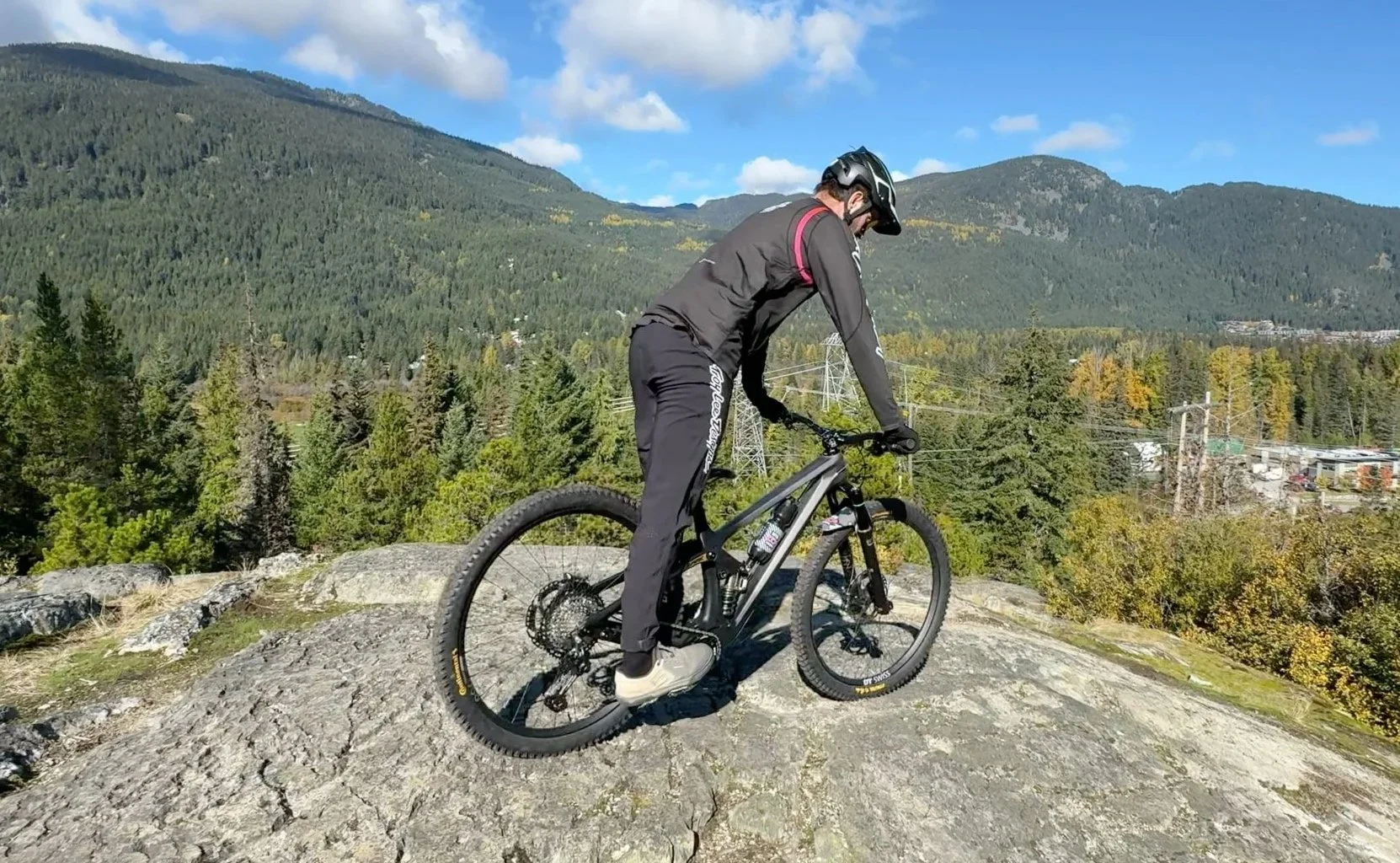
The modern Neutral position : tall and relaxed - tall does not mean stiff! With less fatigue, riders are more mobile and ready to get lower, move or adjust instantly.
To keep things simple, it helps to think of Neutral as the primary riding position — the position riders move from, rather than constantly switching between multiple fixed positions.
Neutral is a balanced, relaxed stance that allows riders to move freely and adapt to changing terrain.
Key characteristics include:
pedals level
standing on the bike
chin roughly over the stem
tall, relaxed posture
light hands and weight primarily in the feet
This position keeps riders centered between the wheels, allowing them to remain stable while still having the mobility needed to adjust to terrain.
Rather than trying to hold a specific “low position,” riders should think about moving dynamically from Neutral as the trail demands.still having the stability needed for challenging terrain.
Adjusting From Neutral
From Neutral, riders can move lower, wider, or shift pressure slightly forward or backward depending on what the terrain requires.
For example:
On steeper or rougher terrain, riders may lower their body slightly to increase stability and range of movement.
When the trail smooths out, riders can return to a taller, more relaxed stance to conserve energy.
In corners or technical terrain, riders may hinge at the hips and widen their stance to maintain stability and control.
The key is that these movements are temporary adjustments, not positions riders should try to hold all the time.
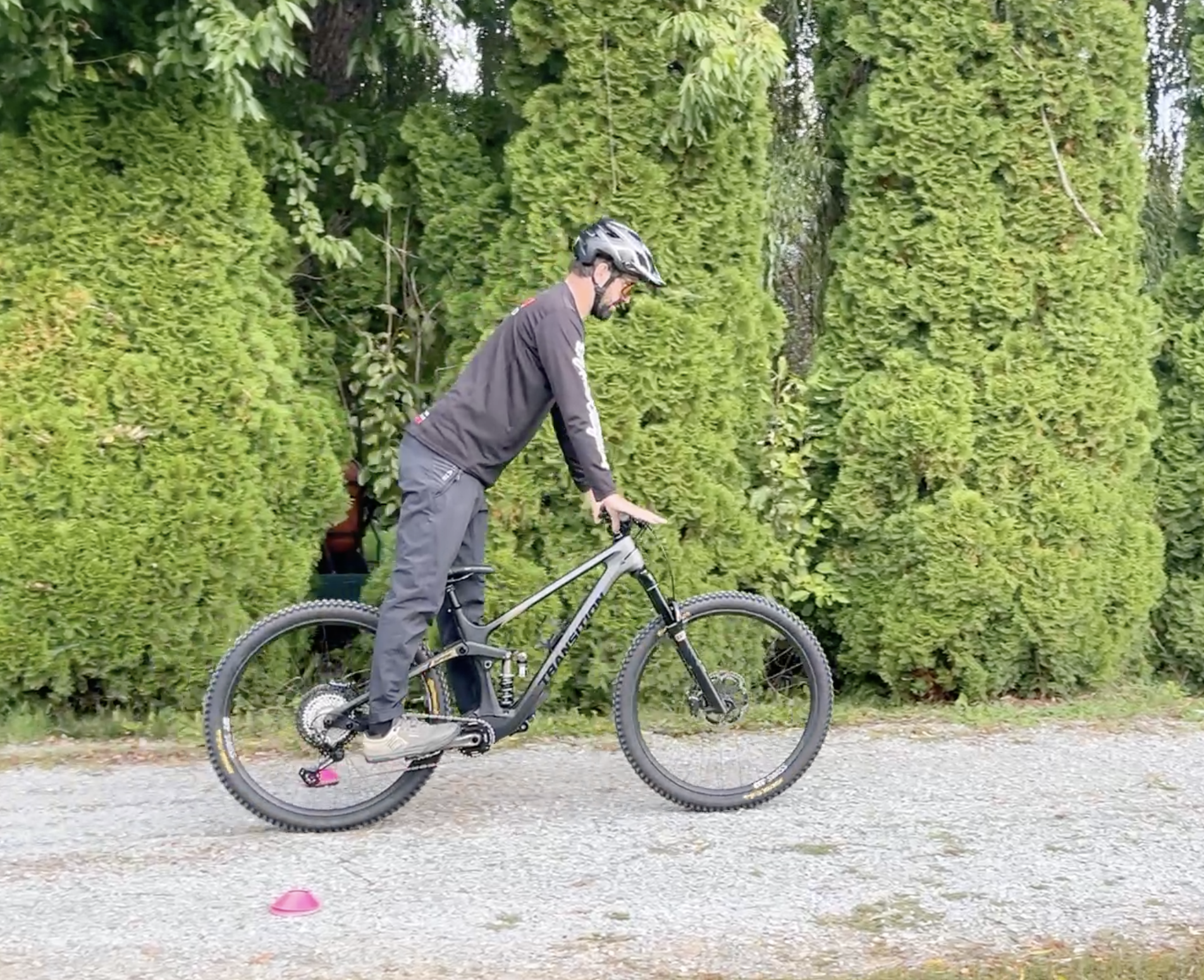
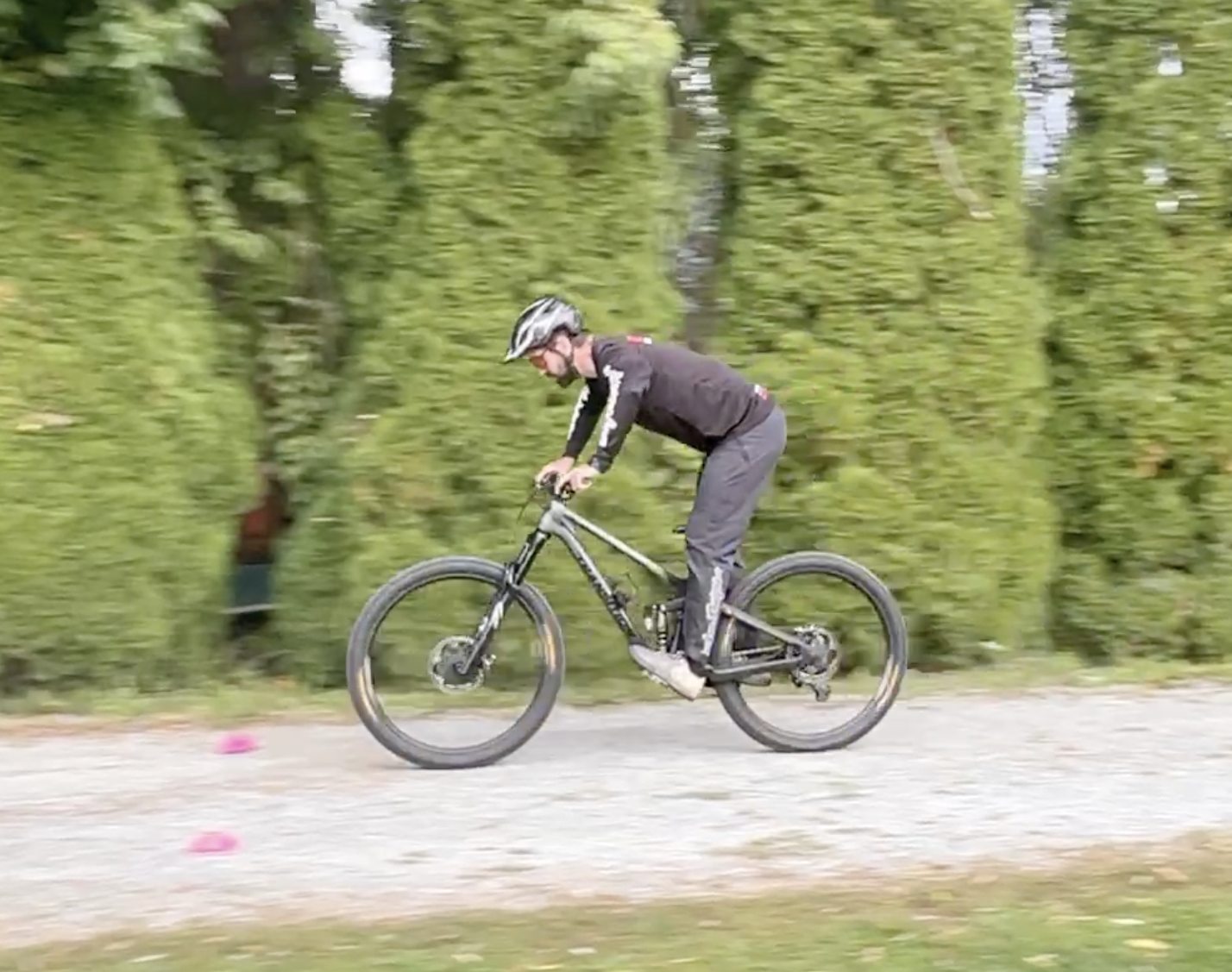
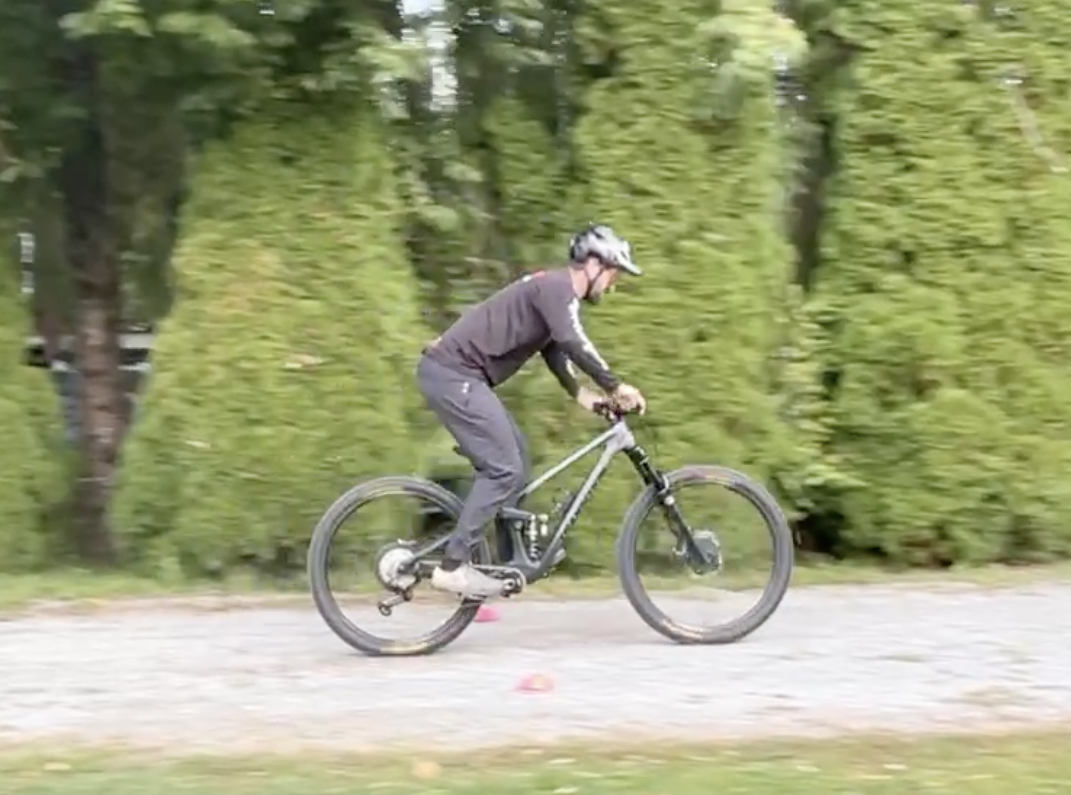
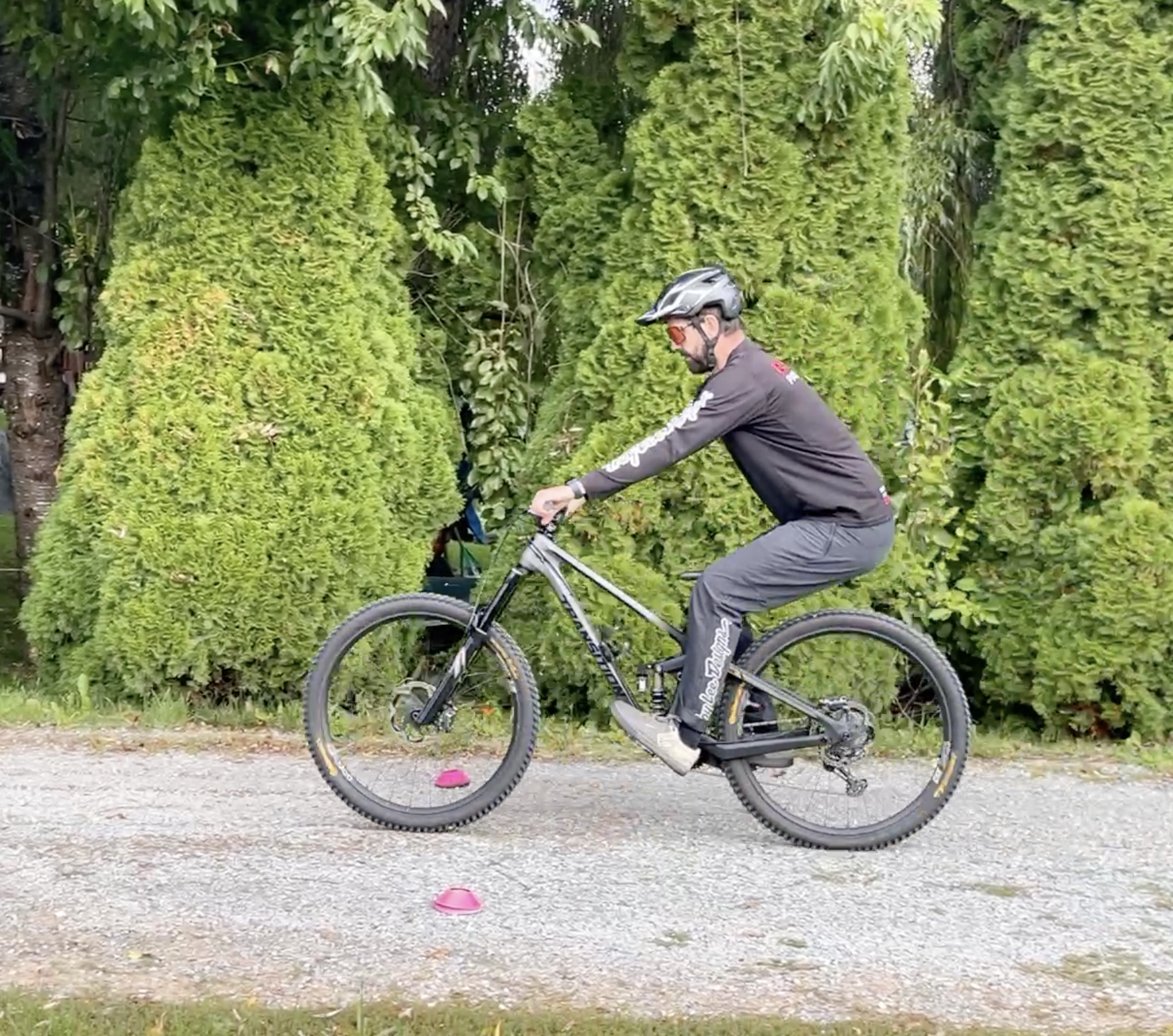
Pic 1 (left to right): Neutral position - extending the arms and legs can ‘reset’ the rider into a natural, tall neutral position - centred between the wheels
Pic 2: Getting low starts with bending the hips and elbows first to ‘hinge’ at the waist and ‘flatten’ the back. This improves range of movement in the arms to steer and move the bike, lowers the rider’s centre or mass while keep the legs stacked for efficiency. With experience, riders can bend all the joints together AND stay centred (chin over stem).
Pic 3: Of course, the rider can bend their knees, but only after bending the hips and elbows. We say “you can bend the knees but only when you need, please!”
Pic 4: Many riders bend their knees first to get low. This causes their legs to collapse, moving the hips behind the feet and their centre of mass towards the rear of the bike. They lose stability, front end traction and efficiency.
Avoid Getting Stuck Low
One of the common habits we now see with both riders and coaches is spending too much time riding low.
While lowering the body can improve stability in certain situations, staying low constantly can:
tire the legs quickly
reduce efficiency
make it harder to move dynamically on the bike
Instead, riders should think about using Neutral as their home base, lowering or adjusting only when the terrain requires it.
Good riding is fluid and adaptable — moving naturally between positions rather than trying to hold a single stance.
A Simple Check
When focusing on body position while riding, I often ask myself two simple questions:
Are my hands light?
If there’s lots of pressure in my palms (less likely) my weight is likely too far forward
If it feels like I’m ‘hanging on’ and my hands are tired or I’m getting arm pump, my weight is likely too far back.
Am I driving the bike, or just surviving?
Survival often looks (and feels) like the rider is static and tense.
Someone ‘driving’ the bike is relaxed and mobile, able to make adjustments or specific movements whenever they need.
If your hands feel good and you can actively adjust the bike and respond to terrain, you are likely in a strong position.
Learning These Skills in Whistler
Many riders visiting Whistler improve dramatically once they understand these fundamentals of Stability & Balance on the bike.
Through Whistler mountain bike lessons and skills clinics, riders can develop stronger fundamentals in:
body position
braking control
cornering technique
terrain management
These skills make steep trails, rock features, and bike park terrain much easier to manage.
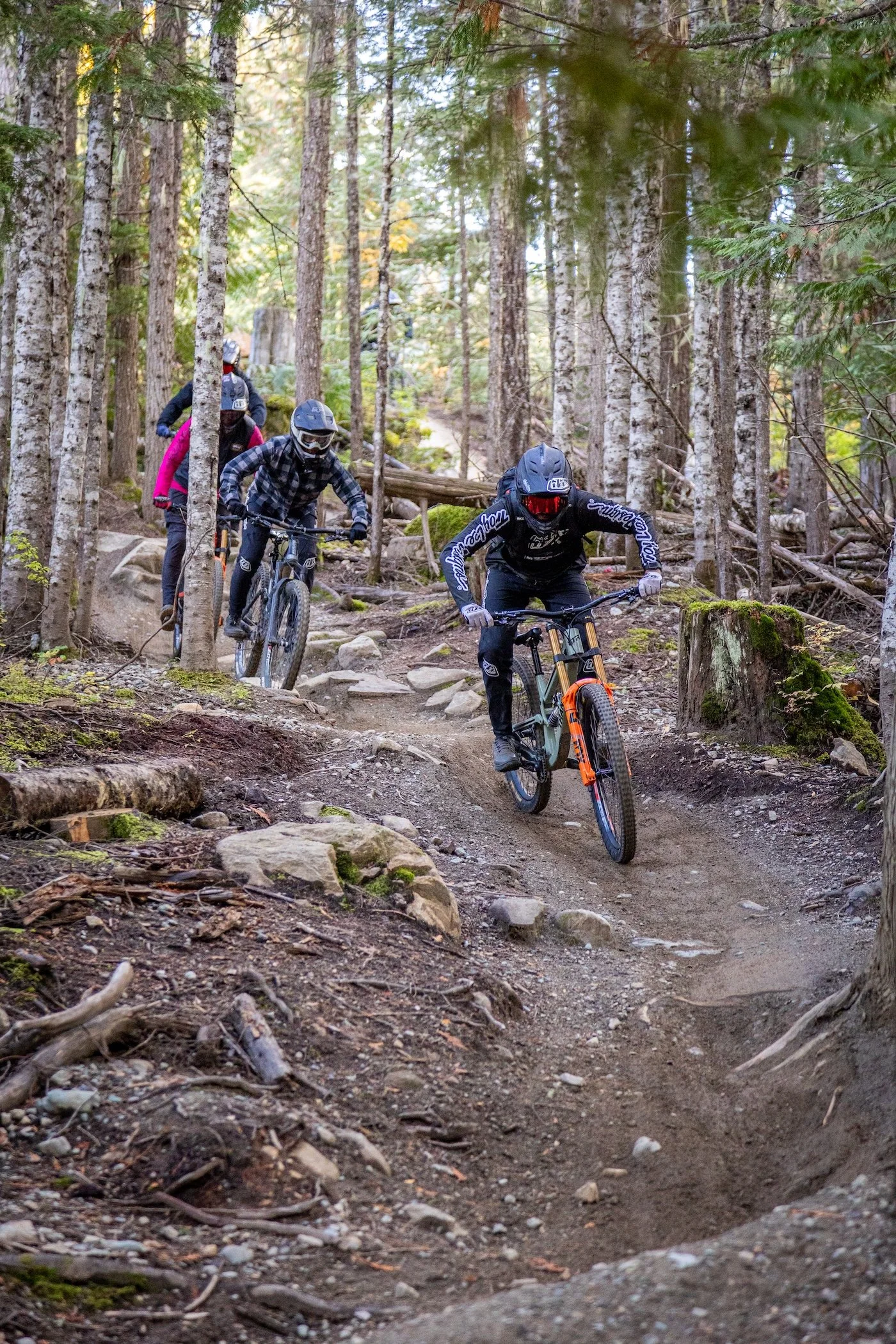
You can see the coach (Paul) bending the elbows and hinging at the waist… with only a minor bend in the knees. In this section, this keeps him centred and mobile, while maintain efficiency in the legs.
About the Author
Paul Howard is the Owner and Head Coach of ZEP Mountain Bike Coaching and the founder of the Global Syndicate of Mountain Bike Coaches (GSMBC).
With more than two decades of experience coaching riders and training mountain bike instructors around the world, Paul has played a key role in developing modern mountain bike coaching systems and instructor certification programs.
He lives in Whistler, BC with his family.
About ZEP
Established in 2006, ZEP Mountain Bike Coaching is a Whistler-based mountain bike coaching company offering:
Whistler mountain bike lessons
Whistler Bike Park coaching
mountain bike skills clinics
youth programs and camps
ZEP focuses on helping riders build strong fundamentals, confidence, and consistency on the bike.
Learn more about ZEP programs here:
https://www.zepmtbcoaching.com